



Special Educational Needs and Disabilities (SEND)
Meet Our SENDCo – Miss Tunstall
Hello, I'm Miss Tunstall. I am passionate about ensuring that every child feels valued, included and supported to reach their full potential. I believe every child deserves the opportunity to thrive, and I am committed to working closely with families and staff to provide the best possible support for pupils with additional needs. Building positive relationships and creating an environment where children feel understood, confident and successful is at the heart of everything I do. A key part of my role is building strong partnerships with parents and carers, teachers, educational psychologists, outside agencies and other professionals. By working collaboratively, we can identify each child's strengths and needs, remove barriers to learning, and ensure they receive the support they need to flourish both academically and personally. Miss Tunstall is contactable through school on 0161725 9750 or via email gorsefield@bury.gov.uk.
At Gorsefield Primary School, inclusion sits at the heart of our mission to ensure that we inspire and challenge all children and adults to excel in everything they do. We believe that all children- regardless of background, need, or circumstance- deserve an exceptional education and the opportunity to reach their full potential.
Inclusion at Gorsefield Primary School is not just about pupils with Special Educational Needs and Disabilities (SEND). It is about identifying and removing any barrier to learning - whether that stems from disadvantage, English as an Additional Language (EAL), social, emotional, or mental health needs, or any other factor that may affect a child’s ability to succeed. Gorsefield provides for a wide range of needs from academic, medical, social, physical and emotional.
Bury SEND Local Offer - Bury Council
How does Gorsefield Identify and Assess SEND?
At Gorsefield, we follow the graduated approach set out in the SEND Code of Practice (2015). This approach recognises that children learn and develop at different rates and that some may require additional support at different points in their education. Where appropriate, increasing levels of specialist expertise are used to identify needs and ensure the right support is put in place.
We recognise that children may experience periods where their progress is affected by factors such as attendance, health, family circumstances or learning English as an Additional Language (EAL). These factors alone do not necessarily mean that a child has Special Educational Needs and/or Disabilities (SEND).
We identify and assess SEND through a range of approaches, including:
- Information shared by parents/carers and previous settings when a child joins Gorsefield.
- Discussions with class teachers, who regularly monitor pupils' progress, attainment and wellbeing.
- Ongoing assessment and careful tracking of each child's progress to identify any emerging concerns.
- Comparing a child's progress and attainment with that of their peers and considering whether they are making expected progress from their individual starting points.
- Classroom observations to identify any barriers to learning.
- Listening to the views of children and their families, as they know their strengths and needs best.
- Information and advice from external professionals, such as health services, speech and language therapists, educational psychologists and specialist advisory teachers, where appropriate.
- Targeted assessments and screening tools to gain a clearer understanding of a child's strengths and areas of need.
If concerns remain after high-quality teaching and targeted support have been provided, we work closely with parents/carers to follow the Assess – Plan – Do – Review cycle, ensuring that support is carefully planned, monitored and adapted to meet the child's needs.
Children may be identified as having SEND if they have needs in one or more of the four broad areas identified in the SEND Code of Practice:
- Communication and Interaction
- Cognition and Learning
- Social, Emotional and Mental Health (SEMH)
- Sensory and/or Physical Needs
At every stage of the process, we believe that working in partnership with children, families and professionals is key to ensuring every child receives the support they need to achieve their full potential.
How are parents involved?
-
At Gorsefield, we believe that parents and carers play a vital role in their child's education. We value your knowledge of your child and work in partnership with families to ensure every child receives the support they need to thrive.
Parents and carers are involved in the SEND process in a variety of ways, including:
- Regular mentoring and review meetings to discuss progress, celebrate successes and agree next steps.
- Invitations to SEND review meetings, where support and provision are discussed collaboratively.
- Receiving and contributing to their child's Individual Provision Map, which is reviewed and shared each half term.
- Ongoing communication with class teachers and the SENDCo to discuss any concerns, share information and review progress.
- Being involved in decisions about referrals to external agencies and the support provided.
We recognise that navigating SEND can sometimes feel overwhelming, and we are committed to supporting families every step of the way. If you have any questions or concerns about your child's needs, please contact your child's class teacher or the SENDCo, who will be happy to help.
Further information and support are also available through the Bury Local Offer, which provides advice, services and guidance for children and young people with SEND and their families.
For more detailed information about the support available at Gorsefield, please refer to our SEND Policy and SEND Information Report.
SEND Core Offer/ Additional Information 2026 2027
- Our Glossary of Terms explains the key words and phrases commonly used in Special Educational Needs and Disabilities (SEND). Whether you are a parent, carer, young person or professional, the glossary provides clear, straightforward definitions to help you understand the terminology used in education, health and social care. It is designed as a quick reference guide to support you when reading reports, Education, Health and Care plans, policies and other SEND-related documents.
Parent Conferencing Meetings
Our parent conferencing meetings are a valued opportunity for parents, carers and school staff to come together, celebrate each child’s unique strengths and achievements, and share in their journey of learning and development. These meetings provide a warm, supportive space to talk about what each child enjoys, what they are doing well and the progress they are making across their personalised curriculum.
Together, we discuss each child’s individual learning and development, including areas such as communication, reading and phonics, mathematics, writing, independence, physical wellbeing, creativity and understanding of the world. We also reflect on personal development, behaviour, attendance, punctuality and home learning, alongside the child’s experiences of overcoming barriers, embracing challenges and celebrating individual differences.
A key part of the conversation is looking ahead and identifying meaningful next steps. Teachers share the progress children are making within their curriculum and parents and carers are encouraged to share their own observations, experiences and aspirations for their child. Together, we consider personal and academic targets that reflect each child’s individual needs, strengths and potential.
For children accessing the Rapid Risers/ Rising Stars provision, conversations also consider areas such as communication, independence, early literacy and the development of fine motor and grip skills, alongside their progress through the Equals semi-formal curriculum.
Above all, these meetings are about partnership. We want families to feel listened to, valued and fully involved in their child’s education. By sharing information, celebrating successes and working together on next steps, we can ensure that every child is supported to develop their confidence, independence and skills, overcome barriers and achieve their individual potential.
Here are examples of Parental/ Carer Conferencing Forms you will see:
Rising Stars Parent/ Carer Conferencing Form
Rapid Risers Parent/ Carer Conferencing Form
Gorsefield also work closely with a wide range of specialist services
Rapid Risers and Rising Stars
Rising Stars and Rapid Risers Transition Booklet
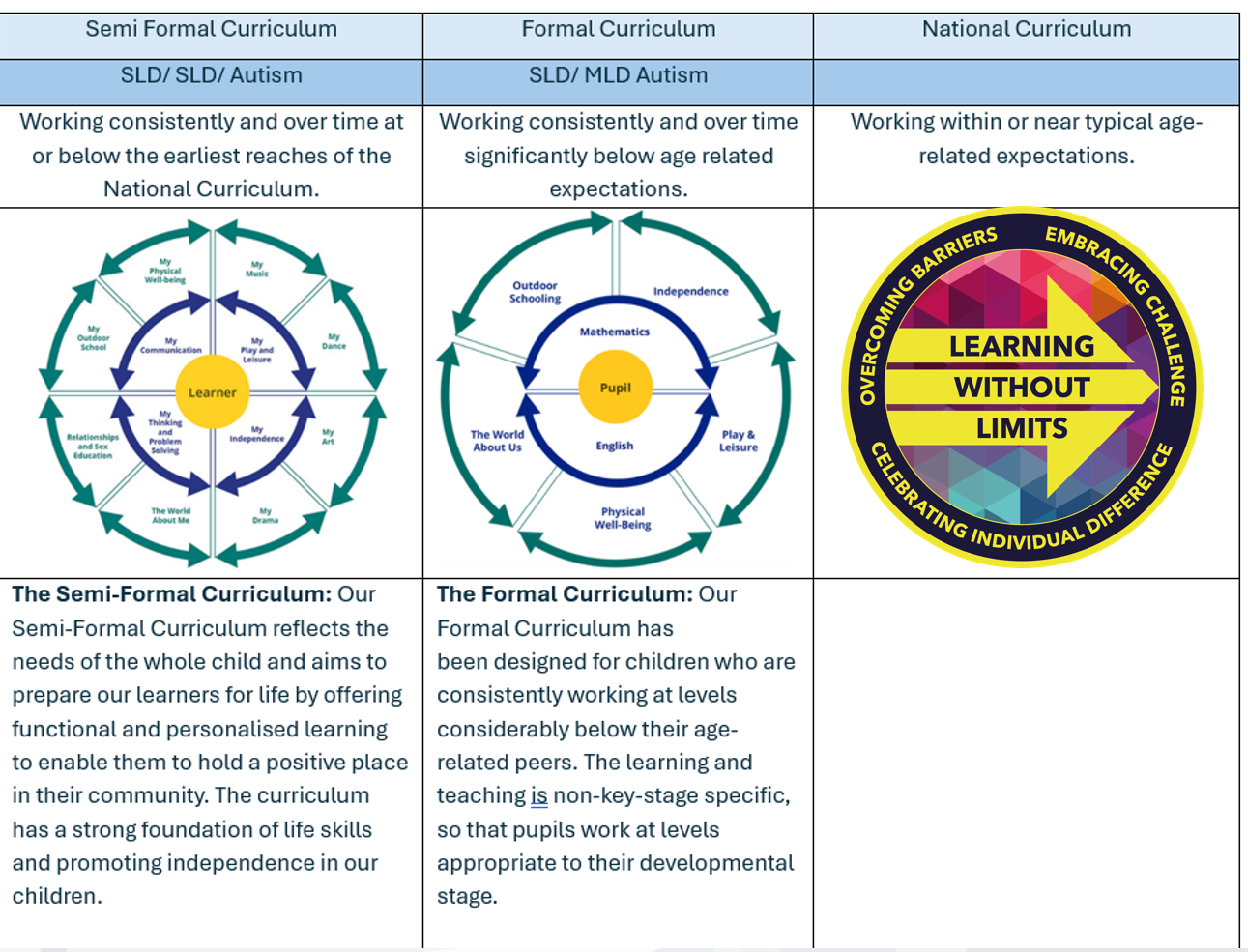
Our curriculum prioritises the essential building blocks for learning, ensuring that every pupil develops the knowledge, skills and confidence needed to become a successful learner. Through carefully planned teaching and personalised support, pupils secure the foundations that enable them to access increasingly ambitious learning, including the National Curriculum, at the right time for them.. We recognise that children develop at different rates and that some require additional time, support and carefully planned teaching to establish these foundations. Through a tailored yet intentional approach, some children access the semi-formal curriculum (Rapid Risers), formal curriculum (Rising Stars), or both.
Both provisions prioritise pupils develop the communication, interaction, attention, emotional regulation, independence and thinking skills that are fundamental to learning. By securing these building blocks first, pupils are equipped to engage with increasingly ambitious learning, access the National Curriculum at the right time for them.
Our curriculum is underpinned by high expectations and a belief that every child can succeed when learning is matched to their individual strengths, needs and stage of development.
Rising Stars Formal Curriculum
Example Timetable:
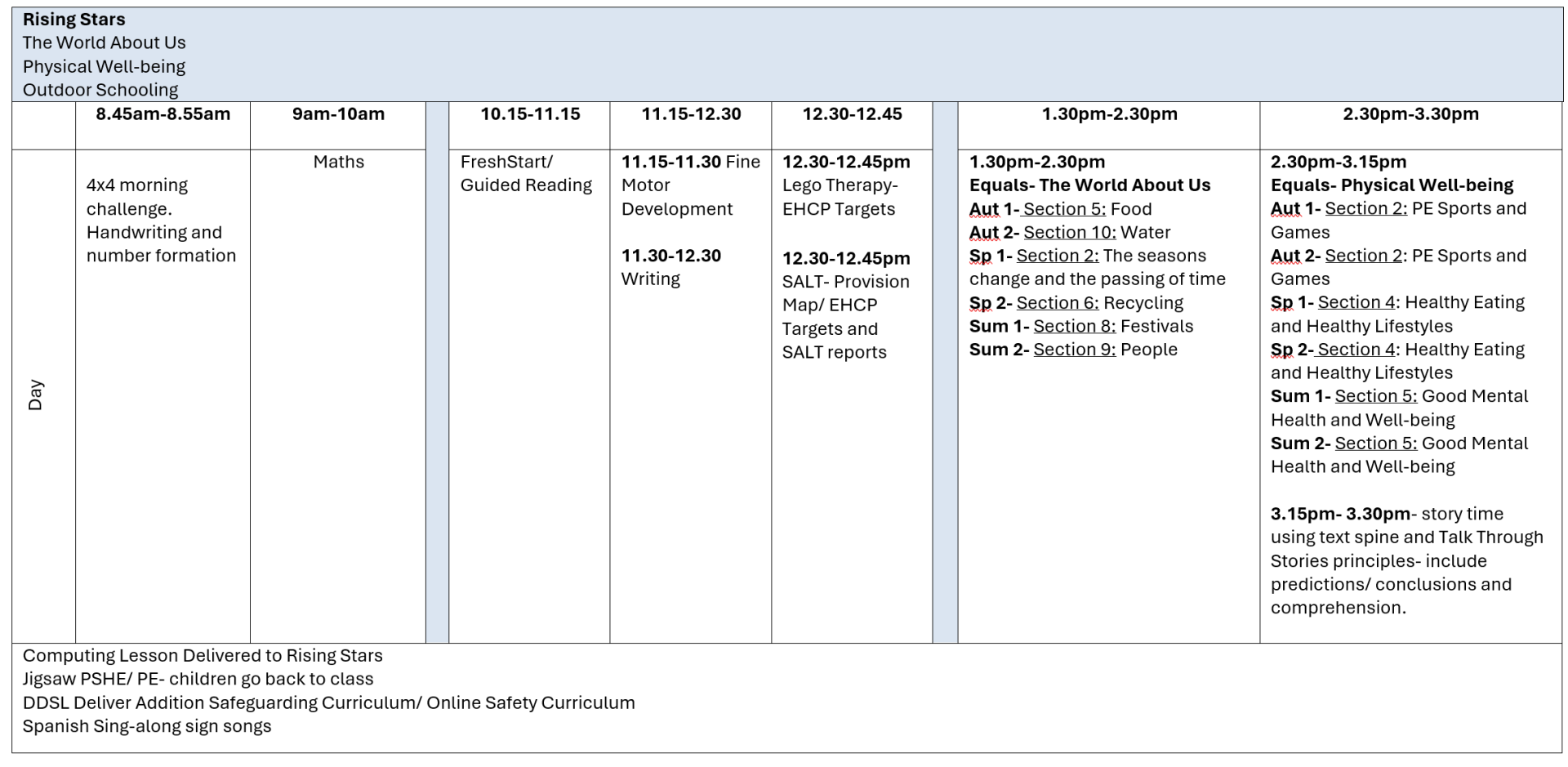
|
Formal Curriculum Long Term Plan |
||||||
|
Equals Units |
Autumn 1 |
Autumn 2 |
Spring 1 |
Spring 2 |
Summer 1 |
Summer 2 |
|
Independence |
Section 2: Shopping |
Section 2: Shopping |
Section 3: Cooking |
Section 3: Cooking |
|
|
|
Play and Leisure |
Free Play: Shared Play |
Free Play: Shared Play |
Free Play: Turn Taking Play |
Free Play: Turn Taking Play |
Free Play: Cooperative Play |
Free Play: Cooperative Play |
|
The World About Us |
Section 5: Food
|
Section 2: The seasons and The change and the passing of time |
Section 10: Water |
Section 6: Recycling |
Section 8: Festivals |
Section 9: People |
|
Physical Well-Being |
Section 2: PE Sports and Games |
Section 2: PE Sports and Games |
Section 4: Healthy Eating and Healthy Lifestyles |
Section 4: Healthy Eating and Healthy Lifestyles |
Section 5: Good Mental Health and Well-being |
Section 5: Good Mental Health and Well-being |
|
Outdoor Schooling |
|
|
|
|
Environmental Awareness |
Creativity |
|
Curriculum Support |
How? |
|
Stage 1 Guided: Directed or assisted by a teacher, to complete the learning/ understand concept and to complete learning task.
|
|
|
Stage 2 Independent: Completed learning without significant assistance. Child relies on own skills and knowledge, maybe asking occasionally for guidance or reassuring questions.
|
|
|
Stage 3 Apply: Child can confidently use own knowledge, skills, or concepts in a specific situation or context.
|
|
|
Stage 4 Adapt: Child can modify or adjust something to fit new learning or context. |
|
Assessment In Rising Stars
Rapid Risers Semi-Formal Curriculum
Example Timetable:
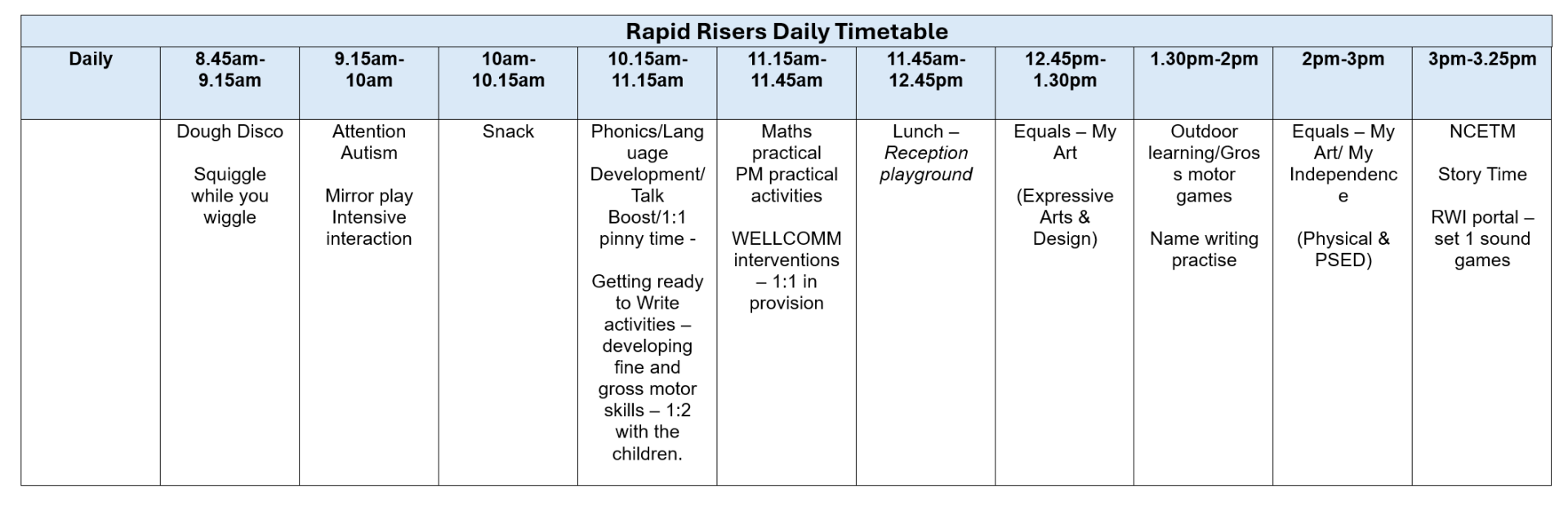
|
Semi Formal Curriculum Long Term Plan |
||||||
|
Equals Units |
Autumn 1 |
Autumn 2 |
Spring 1 |
Spring 2 |
Summer 1 |
Summer 2 |
|
My Communication |
Likes and Dislikes Follow Instructions |
Follow Instructions Gaining Attention |
Responding to Interaction
|
Initiating Interaction
|
Narrating and Retelling
|
Narrating and Retelling |
|
My Art |
Collage
|
Drawing
|
Painting
|
Print Making |
Sculpture
|
Textiles
|
|
My Independence |
Getting Ready to Write: shoulder pivots
|
Getting Ready to Write: elbow pivots
|
Getting Ready to Write: wrist pivots
|
Getting Ready to Write: fine motor |
My Shopping- full unit |
My Travel Training: walking/ balance bikes |
Assessment In Rapid Risers
Assessment in Rapid RisersIn addition, a progression of language framework is used to provoke, provide and evaluate children’s communication and language so that the modelling of language and high-quality questions can be targeted at the appropriate level in order to support children to make strong progress. We assess pupils' language against the Language Framework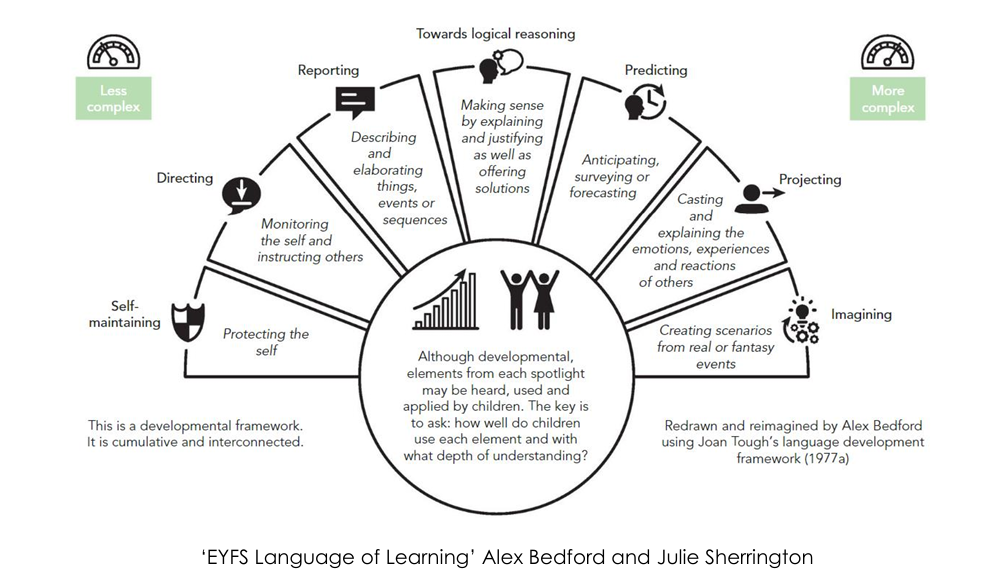
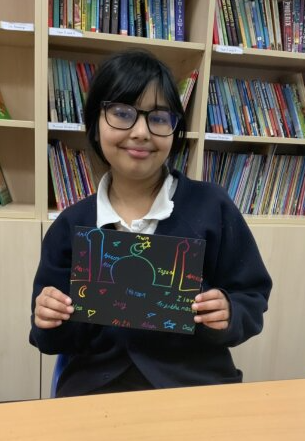
EQUALS Lunchtime Club
 |
 |
 |
| My Art: Fruit Silhouettes | My Independence: Planting Seeds | Celebrating Difference: Prayer Beads |
 |
 |
 |
| Celebration of Scratch Art | Eid Celebrations | The World Around Us: Wind Chimes |